Leith’s A-listed Victoria Swing Bridge Reopens after Refurbishment by Forth Ports
Kiana Greenan
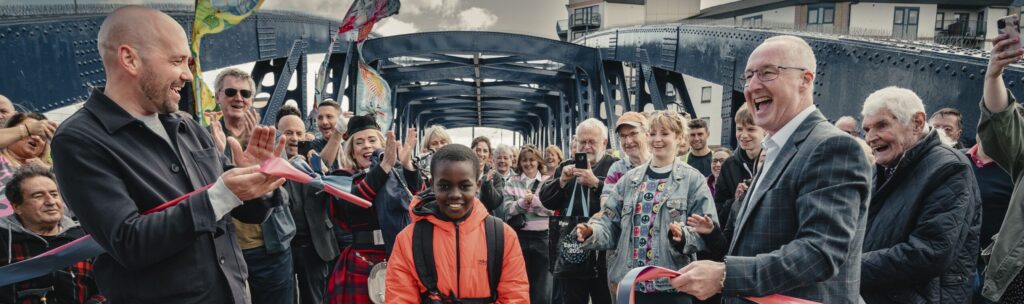
Pictured L-R: local MSP Ben Macpherson, Daniel Ndlovu (13) from Leith and Forth Ports CEO Stuart Wallace officially open the Victoria swing bridge in Leith. Following a full refurbishment by Forth Ports, the Category A Listed Victoria Swing Bridge located at the Port of Leith, was officially reopened this weekend with a walk over procession and a colourful community flag parade.
The refurbishment of the 150 year old bridge, which is the largest counterweighted swing bridge in Scotland, was a programme of specialist works which ensures that the bridge is protected for the future. The repairs were made to the central carriage way which included replacing the existing timber deck, steel work repairs and a full repair and repaint of the well-known blue bridge’s metalwork.
The procession was led by local MSP Ben Macpherson (centre left) and Forth Ports CEO Stuart Wallace (centre right) and three new 6-metre Leith Flags were commissioned by The Port of Leith and created in collaboration with Kinetika and the local community. The colourful flags encapsulate the rich history, the exciting present and ambitious future of Leith through artistic design which has been inspired by local stories, memories and aspirations from the local community.
The reopening of the bridge coincided with a weekend of events as part of the Leith Jazz and Blues Festival and included vintage bus tours around the Port of Leith which were led by the port team themselves.
Commenting on the reopening event, Stuart Wallace, Group Chief Executive Designate at Forth Ports, said: “It is fantastic to be at the reopening of the Victoria Swing Bridge which is an important landmark for the community in Leith. The glorious Leith flags brought colour and creativity to the reopening bridge procession and we are excited to show these flags off to the community. We are grateful to everyone who collaborated in the creation of the flags and I hope the local community enjoyed the vintage bus tours of the port. I know our team had a great time leading the tours and showing the dramatic, innovative redevelopment taking place as we build Scotland’s largest offshore renewables hub.”
The Victoria Swing Bridge was designed by Alexander Rendel and opened in 1874 to provide an efficient road and railway route for the port following the completion of construction of Albert Dock in 1869. The bridge was originally B listed but was upgraded to an A listing in 2014. It is constructed of riveted wrought iron, timber and steel and originally carried a double rail track along its central deck (providing access for both trains and road vehicles) and features pedestrian walkways on either side (NB: see Notes to Editors for more detailed information).
10 June 2024 - ends –
Media enquiries only:
Debbie Johnston - 07532 183811 / debbie@sprengthomson.com
About Forth Ports: Forth Ports Limited owns and operates eight commercial ports in the UK – Tilbury on the Thames, Dundee on the Firth of Tay and six on the Firth of Forth – Leith, Grangemouth, Rosyth, Methil, Burntisland and Kirkcaldy. Within and around the Firths of Forth and Tay, Forth Ports manages and operates an area of 280 square miles of navigable waters, including two specialised marine terminals for oil and gas export and provides other marine services, such as towage and conservancy. www.forthports.co.uk @forthports
About the Victoria Swing Bridge: The construction of the Albert Dock (1862-1869) and Edinburgh Dock (1874-1881) to the East end of Leith Harbour made it necessary to provide an efficient road and railway route between docks on the East & West sides of the harbour and led to the construction of the Victoria Swing Bridge from 1871 to 1874. It was designed by Alexander Rendel, with alterations by Peter Whyte in 1896, and includes a pump house to the north. Rendel and Robertson Engineers also worked on both the East side docks throughout this period. The contractors for the foundations were McDonald & Grant and, for the bridge, Skerne Iron Works (late Pease, Hutchison & Co., Darlington who made the ironwork).
The Victoria Swing Bridge is constructed of riveted wrought-iron, timber and steel and carried a double rail track along its central deck whilst also providing vehicular access across its timber deck and pedestrian walkways to each side. Its girders, with an overall length of 212 ft and clear span of 120 ft, are made of wrought iron and the clear roadway width is 24 ft. The gross weight is 620 tons, including 60 tons of timber and 240 tons of kentledge counterweight which was, but is no longer, lifted and easily turned by means of hydraulic rams operated by the hydraulic power station [that was previously] located adjacent on the bank of the Alexandra Dry Dock. Its clear span is said to have been the largest of any swing bridge in the United Kingdom until the opening of Kincardine Bridge in 1937. The bridge remains the largest counterweighted swing bridge in Scotland. The bridge was closed to vehicular traffic in the mid-1990s.
The Victoria Bridge is owned by Forth Ports Limited and is listed Category A by Historic Environment Scotland as a structure of national importance.
Photos by Jamie Simpson/Forth Ports
Following a full refurbishment by Forth Ports, the Category A Listed Victoria Swing Bridge located at the Port of Leith, was officially reopened at the weekend with a walk over procession and a colourful community flag parade.
The six figure investment in the refurbishment of the 150 year old bridge, which is the largest counterweighted swing bridge in Scotland, was a programme of specialist works which ensures that the bridge is protected for the future. Repairs were made to the two pedestrian walkways and the central carriageway which included replacing the existing timber decking, steel work repairs and a full repair and repaint of the well-known blue bridge’s metalwork.
The procession included three new 6-metre Leith Flags which were commissioned by The Port of Leith and created in collaboration with Kinetika and the local community. Local Leith MSP Ben Macpherson, the Citadel Youth Centre and members of the Leith community all took part in the bridge walk at the weekend. The colourful flags encapsulate the rich history, the exciting present and ambitious future of Leith through artistic design which has been inspired by local stories, memories and aspirations from the local community.
The reopening of the bridge coincided with a weekend of events as part of the Leith Jazz and Blues Festival and included vintage bus tours around the Port of Leith which were led by the port team themselves.
Commenting on the reopening event, Stuart Wallace, Group Chief Executive Designate at Forth Ports, said: “It is fantastic to be at the reopening of the Victoria Swing Bridge which is an important landmark for the community in Leith. The bridge work is just one part of the exciting ongoing regeneration activity in Leith of which we are proud to be part of. The glorious Leith flags brought colour and creativity to the reopening bridge procession and we are excited to show these flags off to the community.
“We are grateful to everyone who collaborated in the creation of the flags and I hope the local community enjoyed the vintage bus tours of the port. I know our team had a great time leading the tours and showing the dramatic, innovative redevelopment taking place as we build Scotland’s largest offshore renewables hub.”
The reopening of the Victoria Swing Bridge, coupled with the refurbishments and reopening of the Rennie’s Isle Bridge last year by Teuchters Landing, ensure that the people of Leith have better access around the local shore area. Further work will continue next year on the Victoria Swing Bridge with the refurbishment of the timber decked turning circles. This work will not impact on access for people crossing the bridge.
The Victoria Swing Bridge was designed by Alexander Rendel and opened in 1874 to provide an efficient road and railway route for the port following the completion of construction of Albert Dock in 1869. The bridge was originally B listed but was upgraded to an A listing in 2014. It is constructed of riveted wrought iron, timber and steel and originally carried a double rail track along its central deck (providing access for both trains and road vehicles) and features pedestrian walkways on either side (NB: see Notes to Editors for more detailed information).
If you would like to discuss your communications needs, you can reach our friendly team on +44 (0) 141 548 5191 or send us an email.
Find out more about what we do on the Services page and explore our Work.